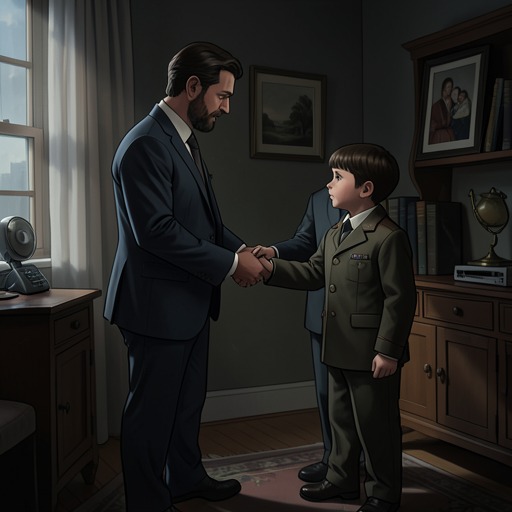
Daniel's first visit to the Cemetery of Forgotten Books
The Shadow of the WindDaniel's first visit to the Cemetery of Forgotten Books changes his life by binding him to a forgotten novel by Julian Carax. Led there at nearly eleven by his father, Daniel enters a secret sanctuary for books in danger of oblivion, accepts the duty of keeping one alive, and chooses The Shadow of the Wind. The visit makes reading an act of guardianship and begins Daniel’s connection with Carax, whose life and work will become central to his own story.
A Secret Threshold
The visit begins before dawn, when Daniel and his father leave their home and make their way from the Ramblas through Calle Arco del Teatro into the Raval quarter. The route passes from the city’s waking streets into a secluded world; at its end stands a large, time-darkened door that Daniel sees as the entrance to a palace of echoes. His father has insisted that Daniel tell no one about what he is about to see, not even his friend Tomas. Secrecy is therefore part of the initiation, not an incidental detail.
Isaac, the cemetery’s guardian, admits them. Daniel’s father introduces him as his son, says that the bookshop will one day be Daniel’s, and explains that the time has come for him to learn about this place. The approach through a shadowed staircase and a gallery of painted creatures gives way to a round hall beneath a glass dome. Bookshelves and walkways rise through it in a vast, intricate structure. For Daniel, still a child, the discovery is both physical and imaginative: the hidden library seems to open another world inside the familiar city.
The Library’s Custodianship
Daniel’s father describes the Cemetery of Forgotten Books as a sanctuary whose books carry the souls of their writers and readers. Their spirits, he explains, grow stronger as books change hands and are read. No one knows when the cemetery began or who created it; his own knowledge comes from what his father told him when he was brought there. The library’s history thus reaches backward across generations, transmitted as a family inheritance rather than a settled record.
Its guardians rescue books when libraries disappear, bookshops close, or works are consigned to oblivion. The books kept there have been lost to public memory, but they remain available for a future reader to find. The cemetery consequently stands in contrast to the ordinary trade of the bookshop: books may be bought and sold, Daniel’s father says, but their deeper purpose is not ownership. Each has already been someone’s companion, and the guardians’ task is to prevent that relationship from being erased altogether.
The visit carries an obligation as well as wonder. By tradition, every first-time visitor must choose one book and adopt it, promising to keep it from disappearing for the rest of their life. Daniel’s father stresses that this is a promise for life and tells him that the choice now belongs to him. The rule turns a private encounter with a book into a lasting responsibility, making the reader its protector as well as its discoverer.
Choosing Carax’s Novel
Daniel spends nearly half an hour wandering among the shelves, where he encounters titles in languages he recognizes and others he cannot identify. He reflects on the many worlds contained within books and contrasts them with the distractions of life outside the library. At the moment of choice, he cannot tell whether chance or destiny has led him to a particular volume: a book in wine-coloured leather whose title is printed in gold. It is The Shadow of the Wind, by Julian Carax, an author Daniel has never heard of.
Daniel takes the book down carefully and turns its pages. A cloud of golden dust rises from it as it leaves its place on the shelf. He carries it out under his arm, convinced that it had been waiting for him, perhaps for years or even before his birth. This feeling of mutual selection complicates the formal rule of adoption: Daniel believes not only that he has chosen the novel, but that the novel has chosen him.
Reading and the Beginning of a Bond
That afternoon, back in the apartment on Calle Santa Ana, Daniel shuts himself away to read. The novel follows a man searching for the father he never knew, a quest that becomes entangled with lost youth and a cursed love. Its narrative unfolds as a sequence of stories nested within one another, like Russian dolls, and multiplies into reflections. Daniel reads through the night, so absorbed that the cathedral bells at midnight scarcely register; he reaches the last page at dawn and resists closing his eyes because he does not want the spell to end.
The choice therefore immediately fulfils the cemetery’s promise: a forgotten work reaches a new reader and acquires renewed life through his attention. Daniel’s adoption is not just a symbolic pledge. He begins to live with the novel’s characters and story, and the book’s mysteries take root in his imagination. His later recollection of wanting a pen to write with, and his father’s promise to buy one if he completed a first work, shows how literary ambition briefly follows this formative reading before the enthusiasm gives way to childhood interests in mechanical toys. The book itself, however, remains the lasting connection.
A Choice That Reaches Beyond the Visit
The novel’s author is not merely a name on a cover. Daniel’s selection of Carax’s book becomes the first link in a larger chain of encounters with Carax’s past and with the people connected to it. The story Daniel reads—its search for an unknown father, its lost youth, and its haunting love—also establishes patterns that will echo through the life he later investigates. The Cemetery gives Daniel no explanation of who Carax is; instead, it places the book in his hands and leaves its questions open.
The significance of the visit also reverberates through the spaces Daniel encounters later. In the Aldaya mansion, he descends into a crypt and reads Penelope Aldaya’s name and dates, 1902–1919, on a coffin; later, Julian confronts the paired tombs of Penelope and David Aldaya, both marked with 1919. Much later, the mansion itself has been restored and repurposed as an advertising agency. These later scenes make the Cemetery’s promise to preserve forgotten books resonate with the precarious survival of human stories: buildings change use, lives disappear from memory, and a reader’s act of attention can keep a past from vanishing without a trace.